 e6c1ce9aa9
* feat(nodes): add stable panel GUID identity (multi-hop phase 0)

Per-panel autoincrement node ids are meaningless one hop away, so in a chained topology (Node1 -> Node2 -> Node3) the master cannot attribute online clients or inbounds to the physical node that hosts them (#4983).

Introduce a stable self-identifier: each panel generates and persists a panelGuid (settings table, mirroring GetSecret), returns it in panel/api/server/status, and the master learns it per node via the heartbeat into a new Node.Guid column. Guarded so an old-build node or a failed probe never clears a known GUID. No behavior change yet - this is the identity foundation Phases 1-2 key on.

Refs #4983

* feat(nodes): attribute inbounds to their origin node by GUID (multi-hop phase 1)

Add Inbound.OriginNodeGuid: the GUID of the panel that physically hosts an inbound. Empty means this panel's own xray; set means it was synced from a node. SetRemoteTraffic now fills it per synced inbound - keeping a non-empty value the node forwarded from its own sub-node (so a transitive inbound stays attributed to the deepest node across hops), and otherwise attributing the node's own local inbounds to that node's GUID. Empty (old-build node without a GUID) leaves the existing node_id-based attribution untouched.

The field rides the existing inbound JSON, so /list propagates it up the chain with no serve-side change. Phase 2 will key per-node online off this instead of the panel-local node_id.

Refs #4983

* feat(nodes): key online status by node GUID end-to-end (multi-hop phase 2)

Replace the panel-local node-id keying of per-node online status with the stable panelGuid, so a client several hops down a node chain is attributed to the node that physically hosts it instead of the intermediate node it syncs through (#4983).

xray/process.go stores each direct node's reported GUID-keyed subtree and merges them (correct at any depth); the service assembles GetOnlineClientsByGuid (own clients under this panel's GUID + every node under its GUID). FetchTrafficSnapshot fetches the new /clients/onlinesByGuid, falling back to the flat /onlines for old-build nodes (keyed under the node's GUID or a master-local synthetic id). The node rollup, the WS onlineByGuid/activeInbounds fields, and the inbounds-page rollup all scope by GUID; local inbounds get their OriginNodeGuid filled with the panel's GUID at serve time so the frontend keys uniformly.

Old-build nodes degrade to the prior flat behaviour via the synthetic node:<id> key. Refs #4983

Refs #4983

* feat(nodes): surface transitive sub-nodes on the master (multi-hop phase 3a)

Each panel publishes read-only summaries of the nodes it manages via GET /panel/api/server/descendants (node API token). The heartbeat job caches each direct node's summaries; GetNodeTree merges them as transitive model.Node projections (Id 0, Transitive=true, ParentGuid = their parent node's GUID) and recomputes InboundCount/OnlineCount/DepletedCount per origin GUID so a direct node shows only its own inbounds and each sub-node shows its own (#4983).

The Nodes-page list endpoint and the heartbeat broadcast now return the tree; GetAll stays direct-only for probing/syncing. One transitive level is surfaced (covers Node1->Node2->Node3); deeper recursion is a follow-up. Backend only - the Nodes-page nested UI lands next.

Refs #4983

* feat(nodes): render transitive sub-nodes nested + read-only on the Nodes page (multi-hop phase 3b)

The Nodes page now shows a node's downstream sub-nodes (learned via the descendants tree) as indented, read-only rows ordered right under their parent: no enable toggle, probe, edit, delete, update, selection, or history expander - just a 'Sub-node' tag whose tooltip names the parent it is reached through. Desktop table and mobile cards both handle it. Transitive rows are keyed by GUID (their Id is 0) so they don't collide with real nodes (#4983).

Rows nest by parentGuid rather than AntD tree-children to avoid clashing with the existing per-row history expander. New labels added to en-US (other locales fall back until translated). Refs #4983

Refs #4983

* i18n(nodes): translate subNode/subNodeTip across all locales

Phase 3b added these two Nodes-page keys (read-only sub-node tag + tooltip) only to en-US; fill in the other 12 locales so the multi-hop sub-node UI is fully localized. The {parent} placeholder is preserved in every translation.

Refs #4983
English | فارسی | العربية | 中文 | Español | Русский





3X-UI is an advanced, open-source web control panel for managing Xray-core servers. It provides a clean, multi-language interface for deploying, configuring, and monitoring a wide range of proxy and VPN protocols — from a single VPS to multi-node deployments.
Built as an enhanced fork of the original X-UI project, 3X-UI adds broader protocol support, improved stability, per-client traffic accounting, and many quality-of-life features.
Important
This project is intended for personal use only. Please do not use it for illegal purposes or in a production environment.
Features
- Multi-protocol inbounds — VLESS, VMess, Trojan, Shadowsocks, WireGuard, Hysteria2, HTTP, SOCKS (Mixed), Dokodemo-door / Tunnel, and TUN.
- Modern transports & security — TCP (Raw), mKCP, WebSocket, gRPC, HTTPUpgrade, and XHTTP, secured with TLS, XTLS, and REALITY.
- Fallbacks — serve multiple protocols on a single port (e.g. VLESS and Trojan on 443) using Xray's fallback support.
- Per-client management — traffic quotas, expiry dates, IP limits, live online status, and one-click share links, QR codes, and subscriptions.
- Traffic statistics — per inbound, per client, and per outbound, with reset controls.
- Multi-node support — manage and scale across multiple servers from a single panel.
- Outbound & routing — WARP, NordVPN, custom routing rules, load balancers, and outbound proxy chaining.
- Built-in subscription server with multiple output formats.
- Telegram bot for remote monitoring and management.
- RESTful API with in-panel Swagger documentation.
- Flexible storage — SQLite (default) or PostgreSQL.
- 13 UI languages with dark and light themes.
- Fail2ban integration for enforcing per-client IP limits.
Screenshots
Click to expand


Quick Start
bash <(curl -Ls https://raw.githubusercontent.com/mhsanaei/3x-ui/master/install.sh)
During installation a random username, password, and access path are generated. After installation, run x-ui to open the management menu, where you can start/stop the service, view or reset your login credentials, manage SSL certificates, and more.
For full documentation, please visit the project Wiki.
Supported Platforms
Operating systems: Ubuntu, Debian, Armbian, Fedora, CentOS, RHEL, AlmaLinux, Rocky Linux, Oracle Linux, Amazon Linux, Virtuozzo, Arch, Manjaro, Parch, openSUSE (Tumbleweed / Leap), Alpine, and Windows.
Architectures: amd64 · 386 · arm64 (aarch64) · armv7 · armv6 · armv5 · s390x.
Database Options
3X-UI supports two backends, chosen during the install:
- SQLite (default) — a single file at
/etc/x-ui/x-ui.db. Zero setup, ideal for small and medium deployments. - PostgreSQL — recommended for high client counts or multi-node setups. The installer can install PostgreSQL locally for you, or accept a DSN to an existing server.
At runtime the backend is selected via environment variables (the installer writes these to /etc/default/x-ui for you):
XUI_DB_TYPE=postgres
XUI_DB_DSN=postgres://xui:password@127.0.0.1:5432/xui?sslmode=disable
Migrating an existing SQLite install to PostgreSQL
x-ui migrate-db --dsn "postgres://xui:password@127.0.0.1:5432/xui?sslmode=disable"
# then set XUI_DB_TYPE and XUI_DB_DSN in /etc/default/x-ui and restart:
systemctl restart x-ui
The source SQLite file is left untouched; remove it manually once you have verified the new backend.
Docker
The default docker compose up -d keeps using SQLite. To run with the bundled PostgreSQL service, uncomment the two XUI_DB_* env lines in docker-compose.yml and start with the profile:
docker compose --profile postgres up -d
The image bundles Fail2ban (enabled by default) to enforce per-client IP limits. Fail2ban bans offenders with iptables, which requires the NET_ADMIN capability. docker-compose.yml already grants it via cap_add; if you start the container with docker run instead, add the capabilities yourself, otherwise bans are logged but never applied:
docker run -d --cap-add=NET_ADMIN --cap-add=NET_RAW ... ghcr.io/mhsanaei/3x-ui
Environment Variables
| Variable | Description | Default |
|---|---|---|
XUI_DB_TYPE |
Database backend: sqlite or postgres |
sqlite |
XUI_DB_DSN |
PostgreSQL connection string (when XUI_DB_TYPE=postgres) |
— |
XUI_DB_FOLDER |
Directory for the SQLite database file | /etc/x-ui |
XUI_DB_MAX_OPEN_CONNS |
Maximum open connections (PostgreSQL pool) | — |
XUI_DB_MAX_IDLE_CONNS |
Maximum idle connections (PostgreSQL pool) | — |
XUI_ENABLE_FAIL2BAN |
Enable Fail2ban-based IP-limit enforcement | true |
XUI_LOG_LEVEL |
Log verbosity (debug, info, warning, error) |
info |
XUI_DEBUG |
Enable debug mode | false |
Supported Languages
The panel UI is available in 13 languages:
English · فارسی · العربية · 中文(简体) · 中文(繁體) · Español · Русский · Українська · Türkçe · Tiếng Việt · 日本語 · Bahasa Indonesia · Português (Brasil)
Contributing
Contributions are welcome. Please read the Contributing Guide before opening an issue or pull request.
A Special Thanks to
Acknowledgment
- Iran v2ray rules (License: GPL-3.0): Enhanced v2ray/xray and v2ray/xray-clients routing rules with built-in Iranian domains and a focus on security and adblocking.
- Russia v2ray rules (License: GPL-3.0): This repository contains automatically updated V2Ray routing rules based on data on blocked domains and addresses in Russia.
Community Tools
Tools and integrations built by the community around 3x-ui.
- terraform-provider-3x-ui (License: MIT): Manage inbounds, clients, panel settings, and Xray configuration as code with Terraform / OpenTofu.
Support project
If this project is helpful to you, you may wish to give it a🌟


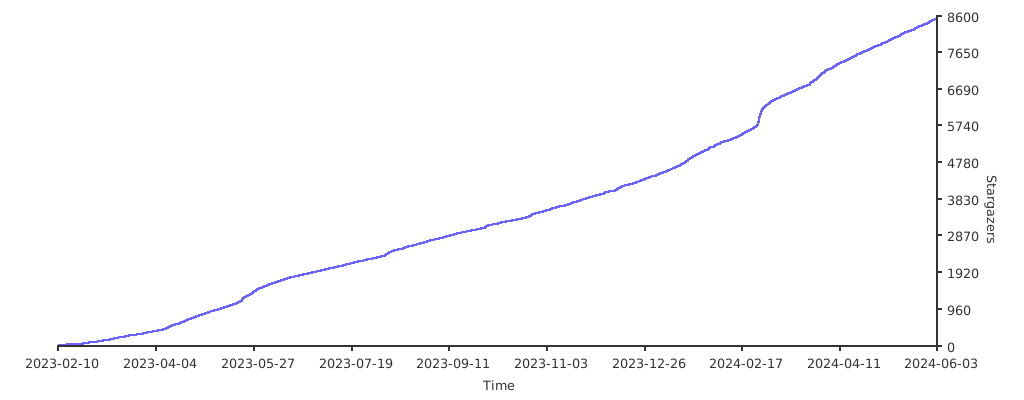
Stargazers over Time