 cfe1b25ca0
* feat(frontend): introduce TanStack Query with status polling

Wires @tanstack/react-query into every entry and migrates useStatus to
useStatusQuery as the foundation for the multi-page MPA → SPA migration.

- QueryProvider wraps each entry inside ThemeProvider, with devtools gated
  on import.meta.env.DEV
- Shared queryClient: 30s staleTime, refetchOnWindowFocus, 1 retry
- useStatusQuery preserves the { status, fetched, refresh } shape so
  IndexPage swaps in without further changes
- refetchIntervalInBackground:false stops the 2s status poll when the
  panel tab is hidden, cutting idle traffic against the server

* feat(frontend): collapse panel pages into a single React Router SPA

Replaces the 7-entry MPA shell (index/clients/inbounds/nodes/settings/
xray/api-docs HTML files) with one main.tsx + createBrowserRouter. The
Go backend now serves the same index.html for every authenticated
panel route; React Router reads the URL and mounts the page from cache
on subsequent navigation — no more full reloads between tabs.

Frontend
- main.tsx: single bootstrap (setupAxios, i18n, ThemeProvider,
  QueryProvider, RouterProvider) replacing 7 near-duplicate entries
- routes.tsx: declarative router with lazy()-loaded pages, basename
  derived from window.X_UI_BASE_PATH so panels at /secret/panel work
- layouts/PanelLayout.tsx: shell mount-point for the WS → queryClient
  bridge so connection survives navigation
- api/websocketBridge.ts: subscribes the singleton WebSocketClient to
  queryClient and dispatches invalidate/outbounds events to cached
  queries (page-level useWebSocket handlers stay until Phase 3 hooks
  migrate)
- AppSidebar: navigates via useNavigate + useLocation instead of
  window.location.href; drops basePath/requestUri props
- Pages: drop the unused basePath/requestUri locals exposed only for
  the old sidebar

Build
- vite.config: 9 rollup inputs → 3 (index, login, subpage). Dev proxy
  bypass collapses /panel/* to index.html and skips API prefixes
- vendor-tanstack + vendor-router chunks added to manualChunks

Backend
- xui.go: 7 per-page HTML handlers → one panelSPA handler serving
  index.html for /, /inbounds, /clients, /nodes, /settings, /xray,
  /api-docs. The /panel/api, /panel/setting, /panel/xray sub-routers
  are untouched

* feat(frontend): migrate useNodes to TanStack Query

Splits the hand-rolled useNodes hook into useNodesQuery (server data +
NodeRecord type + derived totals) and useNodeMutations (add/update/del/
setEnable/probe/test). Mutations invalidate ['nodes'] on success, so
the list refreshes without each call awaiting a manual refresh().

NodesPage drops useWebSocket({ nodes: applyNodesEvent }) — the
WebSocket → query bridge now forwards the 'nodes' push to
setQueryData(['nodes', 'list']) once at the SPA root.

InboundsPage and the inbound form/list components import NodeRecord
from its new home next to the query hook.

* feat(frontend): migrate useAllSetting to TanStack Query

Replaces the hand-rolled fetch + dirty-tracking hook with useAllSettings
backed by useQuery + useMutation. The draft (current edits) is kept in
local state and reset whenever query.data lands. saveAll posts the
draft via a mutation; on success, invalidating ['settings'] refetches
and the useEffect resets the draft so saveDisabled flips back to true.

staleTime: Infinity prevents refetchOnWindowFocus from clobbering
in-flight edits — settings only change in response to this user's own
save.

setSpinning stays as a pass-through to a local flag so the existing
restartPanel flow in SettingsPage keeps showing its spinner.

* feat(frontend): route useInbounds fetches through TanStack Query

Rewrites useInbounds so its four server fetches (slim list, default
settings, online clients, last-online map) live in useQuery with
staleTime: Infinity. The in-place WS merge logic for traffic and
client_stats is preserved — applyTrafficEvent / applyClientStatsEvent
still mutate the locally-mirrored dbInbounds so the panel doesn't
refetch every 1-2 seconds when stats stream in.

refresh() becomes a thin invalidateQueries on the three list keys,
which mutations in the page already call after add/edit/del.

The bridge now forwards the WebSocket 'inbounds' push to
setQueryData(['inbounds', 'slim']), and InboundsPage drops its
useEffect(fetchDefaultSettings → refresh) plus the invalidate /
inbounds wiring on useWebSocket — both are owned by the bridge now.

* feat(frontend): migrate useClients to TanStack Query

Replaces 12 hand-rolled mutation callbacks and a tangle of useState +
useRef + useEffect with one useQuery (paged list) + nine useMutation
wrappers. The list query uses keepPreviousData so paging/filter
changes don't blank the table mid-fetch.

The setQuery shallow-compare logic is preserved for backward
compatibility with ClientsPage's effect that rebuilds the params on
every render. Internally setQuery only updates state when the params
actually differ — Query's queryKey equality handles the rest.

WS-driven applyTrafficEvent / applyClientStatsEvent now mutate the
query cache via setQueryData(['clients', 'list', currentParams]) so
per-second stats updates skip a full refetch. applyInvalidate is gone
from the hook — the bridge owns coarse 'clients' invalidation.

ClientsPage drops the invalidate handler from its useWebSocket
subscription; auxiliary queries (inboundOptions, defaults, onlines)
load via TanStack Query and are shared with useInbounds via the same
query keys.

* feat(frontend): route useXraySetting fetches through TanStack Query

Keeps the bidirectional xraySetting ↔ templateSettings editor sync and
the 1s dirty-tracking interval intact (those are local editor state,
not server data). All seven server calls move:

- config + traffic → useQuery on ['xray', 'config'] and
  ['xray', 'outboundsTraffic']
- saveAll → useMutation that invalidates the config query
- resetOutboundsTraffic → useMutation that invalidates the traffic
  query
- restartXray → useMutation (fires the restart, then reads the
  result string)
- resetToDefault → useMutation (fetch default config, push it into
  the editor via setTemplateSettings)

The WebSocket 'outbounds' event already lands in
keys.xray.outboundsTraffic() via the bridge, so XrayPage drops its
useWebSocket({ outbounds: applyOutboundsEvent }) wiring entirely and
the hook no longer exposes applyOutboundsEvent.

A useEffect seeds xraySetting / templateSettings / tags / test URL
from query data on first fetch and on every refetch, mirroring what
the original fetchAll() did.

* fix(frontend): restore per-route document titles in the SPA

When the multi-entry MPA collapsed into a single index.html, every
route inherited the static <title>3X-UI</title> from the shared shell,
so every panel page showed "hostname - 3X-UI" instead of the original
"hostname - Overview / Clients / Inbounds / ...".

usePageTitle reads the current pathname and rewrites document.title
on every navigation, matching the titles the deleted *.html files
used to carry. Mounted in PanelLayout so it covers all panel routes
without each page having to opt in.

The startup applyDocumentTitle() call in main.tsx is gone — the hook
sets the full "hostname - PageTitle" string itself.

* feat(api-docs): expose OpenAPI spec + render Swagger UI in panel

Replaces the hand-rolled API docs UI with industry-standard tooling so
external integrations (Postman, Insomnia, openapi-generator) can
consume the panel API without parsing endpoints.js by hand.

Generator
- frontend/scripts/build-openapi.mjs: walks the existing endpoints.js
  (still the single source of truth) and emits an OpenAPI 3.0.3 spec
  at frontend/public/openapi.json. Handles Gin :param → {param} path
  translation, body / query / path parameter splits, 200 + error
  response examples, and Bearer + cookie security schemes
- npm run build now runs gen:api before vite build, so the spec is
  always in sync with what's documented

Backend
- web/controller/dist.go exposes ServeOpenAPISpec which streams the
  embedded dist/openapi.json with a short Cache-Control. Public
  endpoint (no auth) so Postman can fetch it without first logging in
- web/web.go wires GET /panel/api/openapi.json before the auth-gated
  /panel/api router

Panel
- ApiDocsPage now renders swagger-ui-react fed by the basePath-aware
  openapi.json URL. Dark mode is overridden via CSS targeting the
  Swagger UI internals
- CodeBlock / EndpointRow / EndpointSection are gone; the swagger-ui
  vendor chunk (134 KB gzipped) only loads on this lazy route, not on
  every panel page
- vite.config: vendor-swagger manualChunk keeps the new dep out of
  the main vendor bundle

For Postman: import http://<panel>/panel/api/openapi.json. Everything
from /login + /panel/api/* shows up with auth, params, and examples.

* style(api-docs): dark/ultra theme for Swagger UI

Override every visual surface Swagger does not theme on its own:
opblocks, tables, model boxes, form inputs, code blocks, modals,
Servers dropdown, per-endpoint padlocks and expand chevrons. Replaces
Swagger's default light-arrow chevron on selects with a light-fill SVG
positioned at the corner so the dark background-color is visible.

Also disables deepLinking to silence the noisy v4 underscore warning;
not used in our panel.
English | فارسی | العربية | 中文 | Español | Русский





3X-UI — advanced, open-source web-based control panel designed for managing Xray-core server. It offers a user-friendly interface for configuring and monitoring various VPN and proxy protocols.
Important
This project is only for personal usage, please do not use it for illegal purposes, and please do not use it in a production environment.
As an enhanced fork of the original X-UI project, 3X-UI provides improved stability, broader protocol support, and additional features.
Quick Start
bash <(curl -Ls https://raw.githubusercontent.com/mhsanaei/3x-ui/master/install.sh)
For full documentation, please visit the project Wiki.
Database Options
3X-UI supports two backends, chosen during the install:
- SQLite (default) — a single file at
/etc/x-ui/x-ui.db. Zero setup, ideal for small/medium deployments. - PostgreSQL — recommended for high client counts or multi-node setups. The installer can install PostgreSQL locally for you, or accept a DSN to an existing server.
At runtime the backend is selected via env vars (the installer writes these to /etc/default/x-ui for you):
XUI_DB_TYPE=postgres
XUI_DB_DSN=postgres://xui:password@127.0.0.1:5432/xui?sslmode=disable
Migrating an existing SQLite install to PostgreSQL
x-ui migrate-db --dsn "postgres://xui:password@127.0.0.1:5432/xui?sslmode=disable"
# then set XUI_DB_TYPE and XUI_DB_DSN in /etc/default/x-ui and restart:
systemctl restart x-ui
The source SQLite file is left untouched; remove it manually once you have verified the new backend.
Docker
The default docker compose up -d keeps using SQLite. To run with the bundled PostgreSQL service, uncomment the two XUI_DB_* env lines in docker-compose.yml and start with the profile:
docker compose --profile postgres up -d
A Special Thanks to
Acknowledgment
- Iran v2ray rules (License: GPL-3.0): Enhanced v2ray/xray and v2ray/xray-clients routing rules with built-in Iranian domains and a focus on security and adblocking.
- Russia v2ray rules (License: GPL-3.0): This repository contains automatically updated V2Ray routing rules based on data on blocked domains and addresses in Russia.
Community Tools
Tools and integrations built by the community around 3x-ui.
- terraform-provider-3x-ui (License: MIT): Manage inbounds, clients, panel settings, and Xray configuration as code with Terraform / OpenTofu.
Support project
If this project is helpful to you, you may wish to give it a🌟


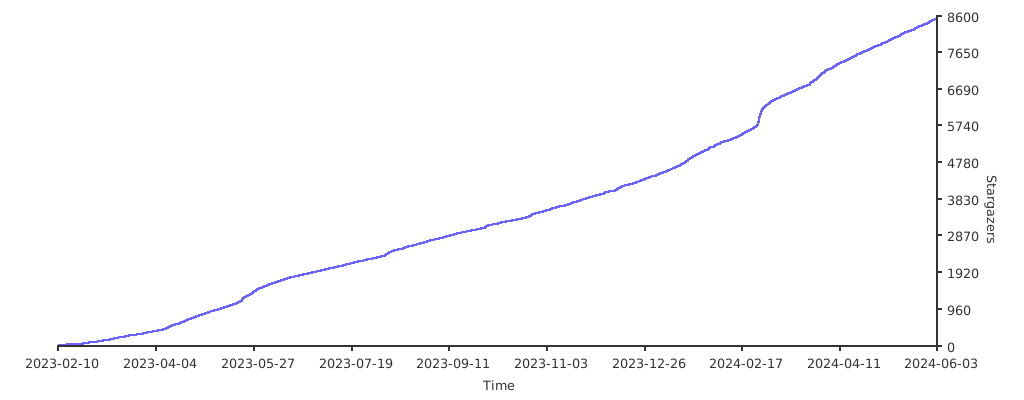
Stargazers over Time