93eda06878
Persistent client groups
- New ClientGroup model + client_groups table that holds empty
  (placeholder) groups so a user can define a label before any client
  references it. ListGroups merges these with the distinct group_name
  values already stored on clients and reports {name, clientCount}.
- ClientRecord gains group_name column; the model.Client wire shape
  gains a matching `group` JSON field that survives the
  inbound.settings → SyncInbound round-trip.
- Rename/Delete on a group mutates client_groups (rename row / delete
  row) AND propagates to all matching clients in ClientRecord and in
  every owning inbound's settings JSON, all in one transaction.

Bulk operations
- AssignGroup(emails, group) updates clients.group_name + patches each
  affected inbound's settings JSON in one read-modify-write per inbound.
  Empty group clears the label. Auto-creates the client_groups row when
  the user assigns to a brand-new name.
- BulkResetTraffic(emails) loops the existing single-reset path so the
  caller can zero traffic across a whole selection or a whole group.
- EmailsByGroup(name) returns just the email list (used by the groups
  page to fan a single bulk action over every member).

Endpoints (all under /panel/api/clients)
- GET  /groups                         — summaries with counts
- GET  /groups/:name/emails            — emails in a group
- POST /groups/create                  — empty placeholder group
- POST /groups/rename                  — rename (table + clients + JSON)
- POST /groups/delete                  — drop label everywhere (clients survive)
- POST /bulkAssignGroup                — assign N selected clients
- POST /bulkResetTraffic               — reset traffic on a list

Clients page UX
- New Group column (Actions → Client → Group → Inbounds → …) with a
  click-to-filter chip.
- FilterDrawer gains a multi-select Group filter whose options come
  from the new ClientPageResponse.groups field (sourced from ListGroups
  so empty/placeholder groups are pickable too).
- Single-client and bulk-add forms gain a Group AutoComplete pre-loaded
  with all known group names.
- New toolbar buttons when selection > 0: "Group ({n})" opens
  BulkAssignGroupModal, "Sub links ({n})" opens SubLinksModal.

Sub-links export modal (new SubLinksModal.tsx)
- Table of selected clients with their subscription URL (and JSON URL
  when subJsonEnable is on), per-row copy, Copy all, and Download as
  sub-links-<timestamp>.txt. Warns when subscription is disabled or
  none of the selected clients have a subId.

Dedicated Groups page (new pages/groups/GroupsPage.tsx)
- /groups route + sidebar entry (TagsOutlined icon) + page title key.
- Card-based layout matching Clients/Inbounds/Nodes — summary card with
  Total/Grouped/Empty stats, main card with Add Group button + table.
- Per-row More dropdown (icon-first column on the left): Sub links,
  Adjust (days+traffic), Reset traffic, Rename, Delete clients in
  group, Delete group (keep clients). Empty groups disable the
  client-targeted actions.
- Reuses SubLinksModal and ClientBulkAdjustModal — emails for the
  group are fetched on demand from GET /groups/:name/emails.

Other polish
- /groups + groups-page selectors added to page-shell.css and
  page-cards.css so the new page inherits the same background, padding,
  card borders, hover shadow, and summary-card padding.
- .card-toolbar gains a small vertical padding so the larger toolbar
  buttons (now default size, matching Inbounds) don't crowd the top of
  the card-head on Clients and Groups pages.
English | فارسی | العربية | 中文 | Español | Русский





3X-UI — advanced, open-source web-based control panel designed for managing Xray-core server. It offers a user-friendly interface for configuring and monitoring various VPN and proxy protocols.
Important
This project is only for personal usage, please do not use it for illegal purposes, and please do not use it in a production environment.
As an enhanced fork of the original X-UI project, 3X-UI provides improved stability, broader protocol support, and additional features.
Quick Start
bash <(curl -Ls https://raw.githubusercontent.com/mhsanaei/3x-ui/master/install.sh)
For full documentation, please visit the project Wiki.
Database Options
3X-UI supports two backends, chosen during the install:
- SQLite (default) — a single file at
/etc/x-ui/x-ui.db. Zero setup, ideal for small/medium deployments. - PostgreSQL — recommended for high client counts or multi-node setups. The installer can install PostgreSQL locally for you, or accept a DSN to an existing server.
At runtime the backend is selected via env vars (the installer writes these to /etc/default/x-ui for you):
XUI_DB_TYPE=postgres
XUI_DB_DSN=postgres://xui:password@127.0.0.1:5432/xui?sslmode=disable
Migrating an existing SQLite install to PostgreSQL
x-ui migrate-db --dsn "postgres://xui:password@127.0.0.1:5432/xui?sslmode=disable"
# then set XUI_DB_TYPE and XUI_DB_DSN in /etc/default/x-ui and restart:
systemctl restart x-ui
The source SQLite file is left untouched; remove it manually once you have verified the new backend.
Docker
The default docker compose up -d keeps using SQLite. To run with the bundled PostgreSQL service, uncomment the two XUI_DB_* env lines in docker-compose.yml and start with the profile:
docker compose --profile postgres up -d
A Special Thanks to
Acknowledgment
- Iran v2ray rules (License: GPL-3.0): Enhanced v2ray/xray and v2ray/xray-clients routing rules with built-in Iranian domains and a focus on security and adblocking.
- Russia v2ray rules (License: GPL-3.0): This repository contains automatically updated V2Ray routing rules based on data on blocked domains and addresses in Russia.
Community Tools
Tools and integrations built by the community around 3x-ui.
- terraform-provider-3x-ui (License: MIT): Manage inbounds, clients, panel settings, and Xray configuration as code with Terraform / OpenTofu.
Support project
If this project is helpful to you, you may wish to give it a🌟


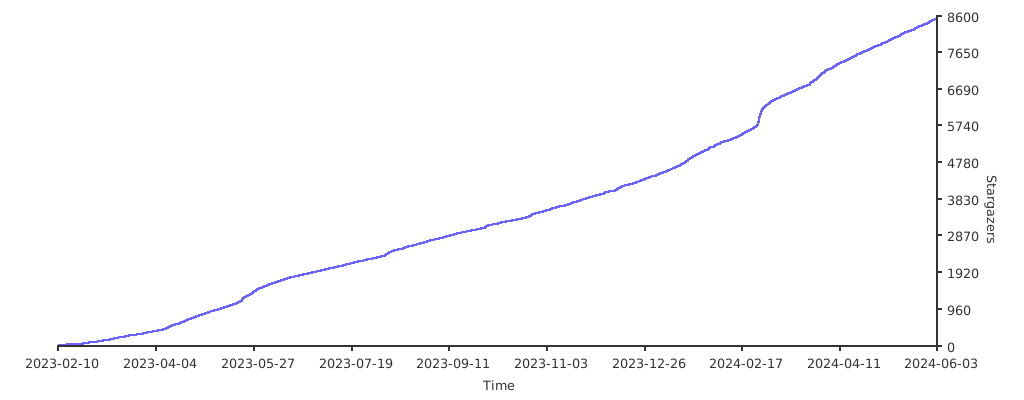
Stargazers over Time