 8046d1519d
The inbound form intentionally only exposes the response side of the
TCP HTTP header object (xray-core's inbound listener reads the
response object, not request — see the existing comment in
InboundFormModal). But the share-link generators were still reading
the Host header from request.headers, so the configured value ended
up in tcpSettings.header.response.headers while the link query
emitted host= (empty).

Fix the host lookup in both code paths:
- sub/subService.go: applyShareNetworkParams (VLESS / Trojan /
  Shadowsocks share URLs) and applyVmessNetworkParams (the VMess
  base64 JSON link) now try header.response.headers first and fall
  back to request.headers for legacy / hand-edited configs.
- frontend/src/lib/xray/inbound-link.ts mirrors the same fallback in
  the three TCP HTTP branches (VMess obj, VLESS params, the shared
  Trojan+Shadowsocks writer) so the JS-side generator used by the
  API docs preview stays in sync with the Go output.

Also restore the request-side inputs (version / method / path /
headers) under the TCP HTTP toggle in InboundFormModal. They were
previously removed because xray-core ignores them on the inbound
side, but they're still useful when copying the same config out to
an outbound or hand-tuning the share link, and they no longer
mislead users about Host — the link now derives Host from
response.headers.host where the response-only form writes it.
English | فارسی | العربية | 中文 | Español | Русский





3X-UI — advanced, open-source web-based control panel designed for managing Xray-core server. It offers a user-friendly interface for configuring and monitoring various VPN and proxy protocols.
Important
This project is only for personal usage, please do not use it for illegal purposes, and please do not use it in a production environment.
As an enhanced fork of the original X-UI project, 3X-UI provides improved stability, broader protocol support, and additional features.
Quick Start
bash <(curl -Ls https://raw.githubusercontent.com/mhsanaei/3x-ui/master/install.sh)
For full documentation, please visit the project Wiki.
Database Options
3X-UI supports two backends, chosen during the install:
- SQLite (default) — a single file at
/etc/x-ui/x-ui.db. Zero setup, ideal for small/medium deployments. - PostgreSQL — recommended for high client counts or multi-node setups. The installer can install PostgreSQL locally for you, or accept a DSN to an existing server.
At runtime the backend is selected via env vars (the installer writes these to /etc/default/x-ui for you):
XUI_DB_TYPE=postgres
XUI_DB_DSN=postgres://xui:password@127.0.0.1:5432/xui?sslmode=disable
Migrating an existing SQLite install to PostgreSQL
x-ui migrate-db --dsn "postgres://xui:password@127.0.0.1:5432/xui?sslmode=disable"
# then set XUI_DB_TYPE and XUI_DB_DSN in /etc/default/x-ui and restart:
systemctl restart x-ui
The source SQLite file is left untouched; remove it manually once you have verified the new backend.
Docker
The default docker compose up -d keeps using SQLite. To run with the bundled PostgreSQL service, uncomment the two XUI_DB_* env lines in docker-compose.yml and start with the profile:
docker compose --profile postgres up -d
A Special Thanks to
Acknowledgment
- Iran v2ray rules (License: GPL-3.0): Enhanced v2ray/xray and v2ray/xray-clients routing rules with built-in Iranian domains and a focus on security and adblocking.
- Russia v2ray rules (License: GPL-3.0): This repository contains automatically updated V2Ray routing rules based on data on blocked domains and addresses in Russia.
Community Tools
Tools and integrations built by the community around 3x-ui.
- terraform-provider-3x-ui (License: MIT): Manage inbounds, clients, panel settings, and Xray configuration as code with Terraform / OpenTofu.
Support project
If this project is helpful to you, you may wish to give it a🌟


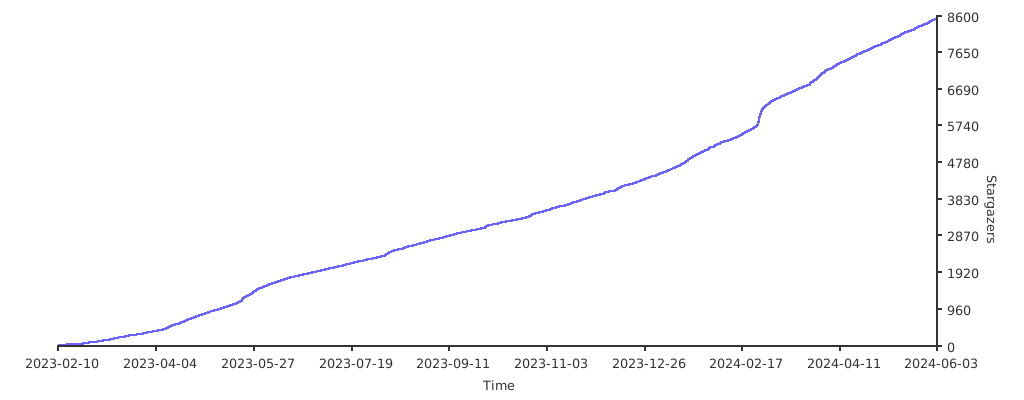
Stargazers over Time