7ade9d9a1f
Tag scheme moves to "[n<nodeID>-]inbound-[<listen>:]<port>-<transport>"
so two long-standing collision classes go away on the create path:
  - tcp/443 and udp/443 on the same listener (independent sockets)
  - same listen+port living on the central panel and on a remote node

Examples:
  local TCP 443    → inbound-443-tcp
  local UDP 443    → inbound-443-udp
  node 1 TCP 443   → n1-inbound-443-tcp

Refactor:
  - composeInboundTag is the single source of truth, called from
    generateInboundTag. Transport segment is now always present
    (used to appear only on collision); n<id>- prefix is added when
    Inbound.NodeID != nil.
  - addInbound / importInbound drop their inline "inbound-<port>"
    fallback; an empty Tag now flows through resolveInboundTag, which
    keeps caller-supplied tags verbatim when free and otherwise
    delegates to generateInboundTag.
  - setRemoteTrafficLocked indexes tagToCentral under both the stored
    tag and the prefix-stripped form, so a node sending its bare tag
    still resolves to a row we may have rewritten at materialization.
    The create branch now picks between snap.Tag and the n<id>-
    prefixed form before falling back to the warn-once skip.
  - Tests updated for the always-on transport suffix, and two new
    cases cover the node-prefix behaviour.

Existing inbounds keep their tags — only newly generated tags adopt
the new shape, so user routing rules pointing at "inbound-443" still
match the row they always did until the row is recreated.
English | فارسی | العربية | 中文 | Español | Русский





3X-UI — advanced, open-source web-based control panel designed for managing Xray-core server. It offers a user-friendly interface for configuring and monitoring various VPN and proxy protocols.
Important
This project is only for personal usage, please do not use it for illegal purposes, and please do not use it in a production environment.
As an enhanced fork of the original X-UI project, 3X-UI provides improved stability, broader protocol support, and additional features.
Quick Start
bash <(curl -Ls https://raw.githubusercontent.com/mhsanaei/3x-ui/master/install.sh)
For full documentation, please visit the project Wiki.
Database Options
3X-UI supports two backends, chosen during the install:
- SQLite (default) — a single file at
/etc/x-ui/x-ui.db. Zero setup, ideal for small/medium deployments. - PostgreSQL — recommended for high client counts or multi-node setups. The installer can install PostgreSQL locally for you, or accept a DSN to an existing server.
At runtime the backend is selected via env vars (the installer writes these to /etc/default/x-ui for you):
XUI_DB_TYPE=postgres
XUI_DB_DSN=postgres://xui:password@127.0.0.1:5432/xui?sslmode=disable
Migrating an existing SQLite install to PostgreSQL
x-ui migrate-db --dsn "postgres://xui:password@127.0.0.1:5432/xui?sslmode=disable"
# then set XUI_DB_TYPE and XUI_DB_DSN in /etc/default/x-ui and restart:
systemctl restart x-ui
The source SQLite file is left untouched; remove it manually once you have verified the new backend.
Docker
The default docker compose up -d keeps using SQLite. To run with the bundled PostgreSQL service, uncomment the two XUI_DB_* env lines in docker-compose.yml and start with the profile:
docker compose --profile postgres up -d
A Special Thanks to
Acknowledgment
- Iran v2ray rules (License: GPL-3.0): Enhanced v2ray/xray and v2ray/xray-clients routing rules with built-in Iranian domains and a focus on security and adblocking.
- Russia v2ray rules (License: GPL-3.0): This repository contains automatically updated V2Ray routing rules based on data on blocked domains and addresses in Russia.
Community Tools
Tools and integrations built by the community around 3x-ui.
- terraform-provider-3x-ui (License: MIT): Manage inbounds, clients, panel settings, and Xray configuration as code with Terraform / OpenTofu.
Support project
If this project is helpful to you, you may wish to give it a🌟


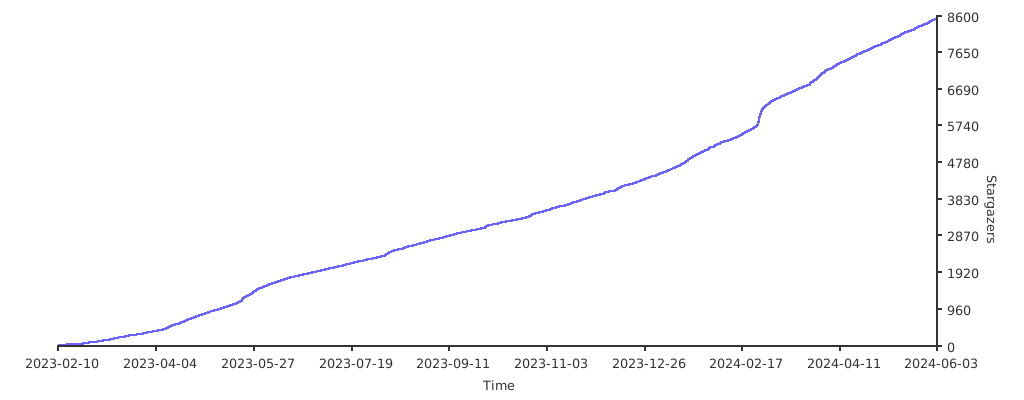
Stargazers over Time