15787dbdfe
Same per-inbound batching strategy as BulkDelete. The previous code
called Update once per email, which itself looped through each inbound
the client belonged to — reparsing the same settings JSON, calling
RemoveUser+AddUser on xray, and running SyncInbound for every single
email. For 200 emails in one inbound that's 200 JSON read/write cycles
and 400 xray runtime calls.

The new BulkAdjust groups emails by inbound and per inbound:

- locks once, reads settings JSON once
- mutates expiryTime/totalGB in place for every target client
- writes the inbound and runs SyncInbound once

ClientTraffic rows are updated with a single per-email query at the end
(values differ per client so they can't be folded into one statement).

For local-node inbounds the xray runtime calls are skipped entirely.
The AddUser payload only contains email/id/security/flow/auth/password/
cipher — none of which change in an adjust — so RemoveUser+AddUser was
a no-op that briefly flapped active users. Limit enforcement is driven
by the panel's traffic loop reading ClientTraffic, not by xray-core.

For remote-node inbounds rt.UpdateUser is preserved so the remote panel
receives the new totals/expiry.

Skip+report semantics match BulkDelete: any per-email error leaves that
email's record/traffic untouched and is returned in Skipped[].
English | فارسی | العربية | 中文 | Español | Русский





3X-UI — advanced, open-source web-based control panel designed for managing Xray-core server. It offers a user-friendly interface for configuring and monitoring various VPN and proxy protocols.
Important
This project is only for personal usage, please do not use it for illegal purposes, and please do not use it in a production environment.
As an enhanced fork of the original X-UI project, 3X-UI provides improved stability, broader protocol support, and additional features.
Quick Start
bash <(curl -Ls https://raw.githubusercontent.com/mhsanaei/3x-ui/master/install.sh)
For full documentation, please visit the project Wiki.
Database Options
3X-UI supports two backends, chosen during the install:
- SQLite (default) — a single file at
/etc/x-ui/x-ui.db. Zero setup, ideal for small/medium deployments. - PostgreSQL — recommended for high client counts or multi-node setups. The installer can install PostgreSQL locally for you, or accept a DSN to an existing server.
At runtime the backend is selected via env vars (the installer writes these to /etc/default/x-ui for you):
XUI_DB_TYPE=postgres
XUI_DB_DSN=postgres://xui:password@127.0.0.1:5432/xui?sslmode=disable
Migrating an existing SQLite install to PostgreSQL
x-ui migrate-db --dsn "postgres://xui:password@127.0.0.1:5432/xui?sslmode=disable"
# then set XUI_DB_TYPE and XUI_DB_DSN in /etc/default/x-ui and restart:
systemctl restart x-ui
The source SQLite file is left untouched; remove it manually once you have verified the new backend.
Docker
The default docker compose up -d keeps using SQLite. To run with the bundled PostgreSQL service, uncomment the two XUI_DB_* env lines in docker-compose.yml and start with the profile:
docker compose --profile postgres up -d
A Special Thanks to
Acknowledgment
- Iran v2ray rules (License: GPL-3.0): Enhanced v2ray/xray and v2ray/xray-clients routing rules with built-in Iranian domains and a focus on security and adblocking.
- Russia v2ray rules (License: GPL-3.0): This repository contains automatically updated V2Ray routing rules based on data on blocked domains and addresses in Russia.
Community Tools
Tools and integrations built by the community around 3x-ui.
- terraform-provider-3x-ui (License: MIT): Manage inbounds, clients, panel settings, and Xray configuration as code with Terraform / OpenTofu.
Support project
If this project is helpful to you, you may wish to give it a🌟


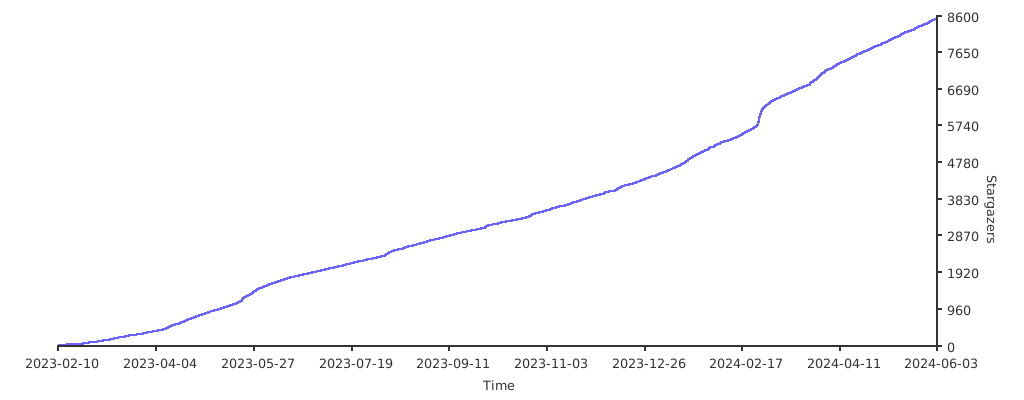
Stargazers over Time